

How to Boost Your Assignment Grades: A Guide for Student Nurses
Uncovering Understanding the Key Elements for Academic Success


Nursing training can be challenging, and your assignments significantly shape your understanding of critical concepts and overall success. As student nurses, developing a strategy to excel in your assignments is crucial, and it's not just about writing something that "sounds good." It's about demonstrating your knowledge, showcasing your critical thinking skills, and ensuring that every piece of work meets all the required learning outcomes.
In this blog, we'll explore tips on improving your assignment grades, including why you should focus on learning outcomes, the importance of critical thinking and reflection, and how proper referencing can make a significant difference.
Understand and Address All Learning Outcomes
Understanding and Addressing All Learning Outcomes: Your Key to Focused Assignments
Every assignment you undertake will have specific learning outcomes or objectives. These outcomes define what you are expected to learn and demonstrate through your work. The purpose of these learning outcomes is to guide your understanding and ensure you are acquiring the necessary skills and knowledge in your nursing education.
How to Achieve This
Read the assignment brief carefully:
Before starting, read the brief multiple times and note the learning outcomes. This will help you understand exactly what your lecturer expects.
Aligning your content with the outcomes is crucial. As you write your assignment, continuously check to see if each section aligns with the required outcomes. For example, if an outcome requires you to 'demonstrate understanding of evidence-based practice,' provide clear, well-researched examples that reflect this. This alignment ensures you understand the expectations and can meet them effectively.
Use headings and subheadings
Organising your work with clear headings that match the learning outcomes can help you stay focused and ensure you don't miss any key areas.
Pro Tip: Before submitting your assignment, review the learning outcomes again and ensure you've covered each one. This simple step can make a huge difference in your grades.
Empower Yourself: develop Critical Thinking and Reflection
Why It's Important:
Critical thinking is an essential skill for all nurses. It involves analysing information, questioning assumptions, and making informed decisions. Conversely, reflection allows you to evaluate and learn from your experiences, which is vital for your growth as a nurse. Demonstrating these skills in your assignments shows you can apply theory to practice, make informed judgments, and learn from real-life experiences.
How to Achieve This:
Question the evidence:
Don't just accept information at face value. Analyse the data, ask questions, and explore alternative perspectives. For instance, if discussing a specific nursing intervention, evaluate its effectiveness, consider the limitations, and compare it with other interventions.
Link theory to practice:
Illustrate your points using real-life experiences or case studies. Reflect on your experiences during clinical placements and discuss how they relate to the theory you've learned.
Using reflective models can significantly enhance your understanding. Structure your reflections using models like Gibbs' Reflective Cycle or Kolb's Learning Cycle. These models provide a structured approach to reflection, helping you analyse your experiences, draw conclusions, and plan how to approach similar situations, thereby enhancing the depth of your understanding.
Pro Tip: When reflecting, focus on what you learned, how you felt, and how this experience will influence your future nursing practice. This level of insight shows depth and understanding, which can significantly enhance your grades.
Back-Up Your Work with Quality References
Why It's Important:
Referencing is not just about avoiding plagiarism; it's about demonstrating that your work is grounded in credible and authoritative sources. Quality references show that you've engaged with existing research, support your arguments, and know the broader context of your subject matter.
How to Achieve This
Use up-to-date, credible sources:
Nursing is an ever-evolving field, and using outdated references can weaken your argument. Ensure you use the most recent research, preferably within the last 5-7 years.
Refer to a mix of sources:
Include peer-reviewed journal articles, textbooks, clinical guidelines, and reputable websites (e.g., NHS, WHO). This variety demonstrates that you've engaged with a broad range of information.
Accurately cite and reference:
Familiarise yourself with the referencing style required by your institution (e.g., APA, Harvard) and apply it consistently throughout your assignment. Use referencing tools like Zotero, EndNote, or Mendeley to help you manage your references.
Pro Tip: Don't just throw in references for the sake of it. Make sure they add value to your arguments and discussions. Please explain how the evidence supports your point and critically analyse its relevance to your topic.
Plan, Draft, and Proofread Your Work
Why It's Important:
Effective planning, drafting, and proofreading are essential to producing high-quality assignments. These steps help ensure your work is well-organised, coherent, and error-free.
How to Achieve This:
Create an outline:
Before you start writing, develop an outline of your assignment. Include the introduction, main body, and conclusion, with a breakdown of what you'll cover in each section.
Draft in stages:
Don't attempt to write your entire assignment in one go. Write in manageable sections, taking breaks to maintain clarity and focus.
Proofread thoroughly:
Check your assignment for spelling, grammar, and punctuation errors. Reading your work out loud or asking a peer to review it can help identify mistakes you might have missed.
Pro Tip: Use tools like Grammarly or Hemingway Editor to catch spelling or grammatical errors. However, don't rely solely on these tools; always do a manual check as well.
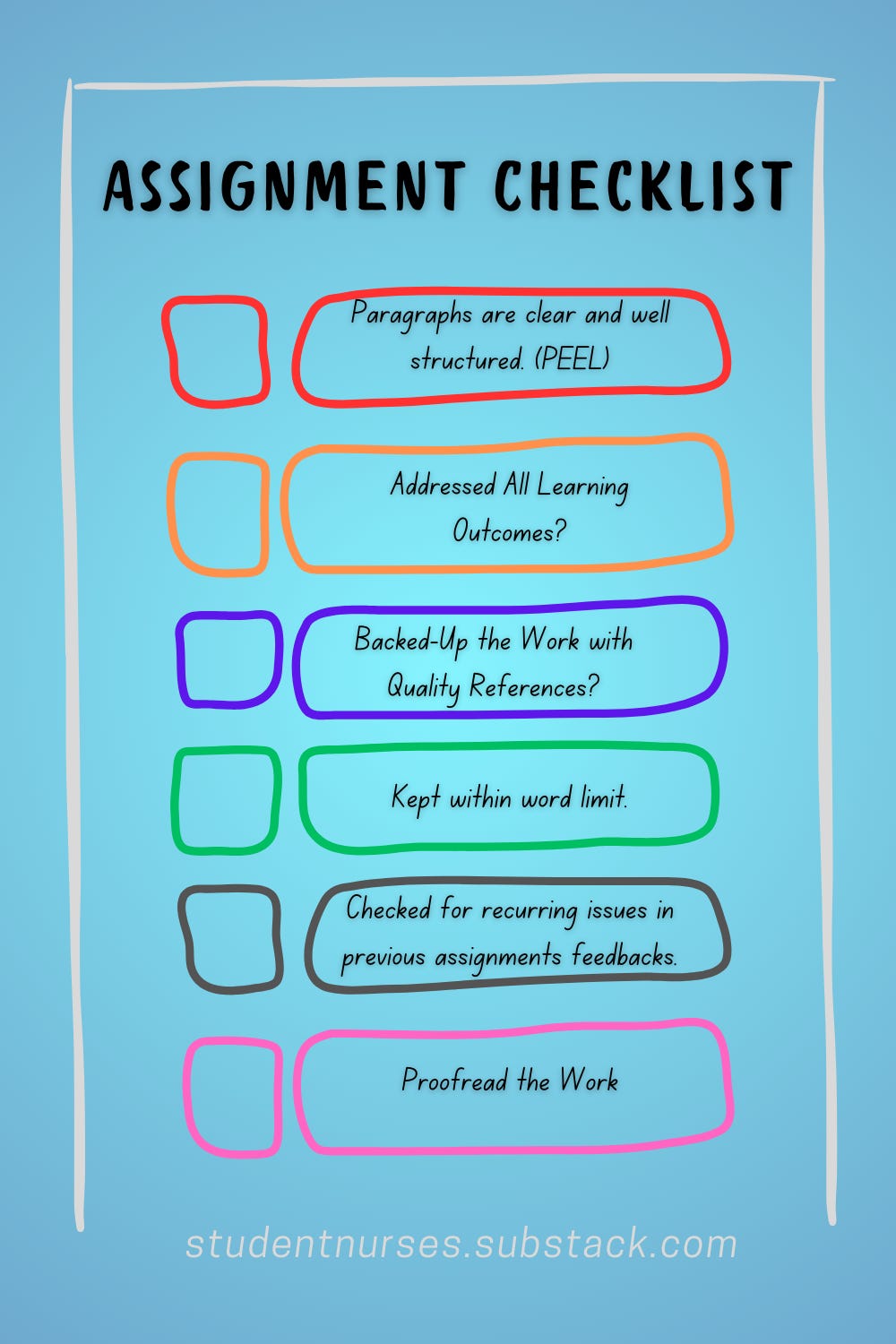
Seek Feedback and Embrace Learning: A Key to Your Growth
Seeking feedback is a crucial step in your improvement and growth. Feedback from your tutors is one of the most valuable tools for improving your assignments. It provides insight into areas where you did well and need improvement, helping you grow as a student nurse.
Feedback from your tutors is one of the most valuable tools for improving your assignments. It provides insight into areas where you did well and need improvement, helping you grow as a student nurse.
How to Achieve This:
Review past feedback:
Before starting a new assignment, review the feedback you've received on previous work. Identify patterns or recurring issues and focus on improving them.
Ask for clarification:
If you don't understand the feedback you received, don't hesitate to ask your tutor for clarification. This shows that you're committed to learning and improving.
Apply the feedback:
Use the feedback to improve your next assignment. For instance, if your tutor mentioned a lack of depth in your analysis, consciously delve deeper into your topic next time.
Pro Tip: Keep a feedback journal where you record every feedback and reflect on how to implement it in future assignments.

Final Thoughts
Boosting your assignment grades as a student nurse requires more than just completing the task – demonstrating your understanding of learning outcomes, engaging in critical thinking and reflection, and supporting your work with credible references. By carefully planning your assignments, seeking feedback, and continuously improving, you'll achieve higher grades and develop the skills and knowledge needed for a successful nursing career.
Remember, each assignment is an opportunity to learn and grow. Approach them with dedication, curiosity, and a willingness to improve, and you'll be well on your way to excelling in your nursing studies. Good luck!